

Inflation affects almost every part of running a business. Supplier prices rise, wages increase, rent goes up, energy costs climb, freight becomes more expensive, and customers may become more price-sensitive at the same time.
For product-based businesses, the impact is especially direct. A restaurant, butcher shop, manufacturer, cafe, grocer, or retailer can see costs rise across dozens or hundreds of inputs at once. Beef goes up. Packaging goes up. Electricity goes up. Delivery fees go up. Even small increases can compound into a serious hit to profitability.
CostBeacon turns this workflow into an invoice-backed system: see the invoice price tracking product, compare plans and trial options, or review our supplier price tracking software page for the commercial overview.
The key idea: inflation is not just an economic headline. For operators, it becomes invoice-level cost changes, thinner product margins, and harder pricing decisions.
What inflation means for business costs
Inflation is the general increase in prices across an economy over time. When inflation rises, the purchasing power of money falls. In practical terms, the same dollar buys less than it did before.
For businesses, inflation usually shows up as higher input costs. The goods and services you rely on to operate become more expensive, and those increases pressure profit margins if selling prices do not rise at the same pace.
Demand-pull inflation can happen when demand rises faster than supply. Cost-push inflation happens when production costs rise, such as raw materials, wages, fuel, rent, or supplier prices. Supply chain disruptions can add another layer when shortages, delays, or geopolitical events make inventory more expensive to secure.
The cost categories inflation affects most
Inflation rarely affects just one line item. It usually spreads through the business in several connected categories.
- Materials and inventory: ingredients, resale inventory, raw materials, components, packaging, and supplies.
- Labor: wages needed to retain staff, hire new workers, and stay competitive in the labor market.
- Energy and utilities: electricity, fuel, heating, refrigeration, machinery, ovens, HVAC, and supplier energy costs passed through invoices.
- Rent and occupancy: commercial rent, maintenance, property taxes, insurance, and renewal increases.
- Freight and delivery: delivery charges, fuel surcharges, minimum order fees, rush fees, freight-in, and courier rates.
These costs affect different businesses in different ways. A software business may be most exposed to wages. A restaurant may be exposed to food, packaging, utilities, and labor. A manufacturer may be exposed to raw materials, energy, freight, and equipment costs.
Example: how inflation compresses profit in a butcher shop
Imagine a small independent butcher shop in London, Ontario. The business sells fresh cuts, sausages, prepared meats, and specialty products. It buys from several meat suppliers and serves local retail customers.
Before inflation pressure increases, monthly revenue is $120,000. Monthly costs are $107,800, leaving $12,200 of profit before tax. Profit margin is $12,200 divided by $120,000, or 10.2%.
Then inflation hits several categories at once: meat and ingredients rise 9%, packaging rises 12%, direct labor rises 6%, utilities and refrigeration rise 15%, rent rises 4%, and other operating expenses rise 5%.
Meat and ingredients
- Before
- $58,000
- After
- $63,220
+$5,220+9%
Packaging and supplies
- Before
- $4,500
- After
- $5,040
+$540+12%
Direct labor
- Before
- $22,000
- After
- $23,320
+$1,320+6%
Utilities and refrigeration
- Before
- $3,800
- After
- $4,370
+$570+15%
Rent and occupancy
- Before
- $7,500
- After
- $7,800
+$300+4%
Other operating expenses
- Before
- $12,000
- After
- $12,600
+$600+5%
Total monthly costs rise from $107,800 to $116,350. If revenue stays at $120,000, monthly profit falls to $3,650. Profit margin drops from 10.2% to 3.0% even though sales did not decline.
Monthly profit
Monthly profit left
How much revenue or savings are needed?
Before inflation, the butcher shop earned $12,200 in monthly profit. After inflation, if prices do not change, it earns $3,650. The profit gap is $8,550 per month.
To recover the full gap through pricing alone, monthly sales would need to rise from $120,000 to $128,550. That is a 7.1% average price increase, assuming sales volume stays the same.
A more realistic path may combine pricing and cost control. A 4% price increase on $120,000 of revenue creates $4,800. That leaves $3,750 to recover through supplier savings, waste reduction, purchasing changes, or operational improvements.
No action
$3,650- Action
- None
- Gap remaining
- $8,550
4% pricing + savings
$12,200- Pricing
- +$4,800
- Cost savings
- +$3,750
7.1% pricing only
$12,200- Pricing
- +$8,550
- Average lift
- 7.1%
How to assess inflation exposure
Not every business is affected by inflation in the same way. Start by asking where cost movement can hurt margins fastest.
- What percentage of revenue goes to COGS?
- Which suppliers represent the largest share of spend?
- Which products or materials have the most volatile prices?
- How often do suppliers change prices?
- Can you pass increases to customers without losing volume?
- Do you have long-term contracts, spot purchasing, or backup suppliers?
- How often do you review gross margin and product-level profitability?
The most vulnerable businesses usually have three traits: high input costs, low pricing power, and poor visibility into supplier price changes. If you do not know which supplier costs are increasing, you cannot respond quickly.
Cost mitigation strategies during inflation
Inflation cannot always be avoided, but it can be managed. The goal is not to cut costs blindly. The goal is to protect margins while preserving quality, customer experience, and supplier relationships.
Monitor supplier price changes after invoices are processed
Many businesses only notice inflation after margins have already declined. Track unit prices, case sizes, freight charges, fuel surcharges, discounts, payment terms, and supplier price changes over time.
Renegotiate with data
Inflation does not mean every supplier increase should be accepted automatically. Use historical spend, unit price history, order volume, alternative quotes, delivery performance, product quality, and invoice accuracy to negotiate from a stronger position.
Reduce waste and review product mix
Waste becomes more expensive during inflation. Spoilage, trim loss, damaged packaging, returned products, obsolete inventory, and production rework all matter more when inputs cost more. Product mix matters too: some products may still carry strong margins while others quietly become unprofitable.
Optimize ordering, freight, and energy use
Overbuying can protect against a future price increase, but it can also create spoilage, storage costs, and cash flow pressure. Review volume discounts, supplier minimums, delivery frequency, freight surcharges, and energy-heavy processes such as refrigeration, ovens, HVAC, or machinery.
Pricing strategies when costs keep rising
Cost mitigation helps, but many businesses still need to raise prices during inflation. The key is to raise prices thoughtfully.
Avoid a flat across-the-board price increase if product-level margins tell a more specific story. Some products may have experienced a 15% supplier increase while others barely changed. Some products may have strong loyalty and pricing power. Others may be more price-sensitive.
Smaller, more frequent adjustments can be easier to manage than one large annual jump. Protecting entry-level products can also help when customers are price-sensitive, while premium or specialty items may carry more pricing flexibility.
Long-term planning for cost volatility
Inflation is not a one-time problem. Strong businesses prepare for cost volatility before it becomes urgent.
Use rolling forecasts that update monthly or quarterly based on actual revenue, COGS, gross margin, labor costs, supplier price changes, inventory levels, cash flow, debt costs, and operating expenses. Maintain a cash buffer so higher inventory costs, payroll, or shorter supplier payment terms do not force expensive borrowing.
Supplier diversity also matters. Relying on one supplier for critical products creates risk if that supplier raises prices aggressively or faces shortages. A balanced supplier base gives you leverage without spreading purchasing power too thin.
How CostBeacon helps spot supplier-driven increases
The businesses that handle inflation best are the ones that see cost changes early. Manual invoice review and spreadsheet tracking can work when invoice volume is low, but they become unreliable as suppliers, products, and locations multiply.
CostBeacon helps businesses turn invoices into structured supplier and item-level cost data. As invoices are uploaded and processed, CostBeacon tracks product price history and helps flag unexpected supplier price changes, making it easier to catch increases before they compress margins.
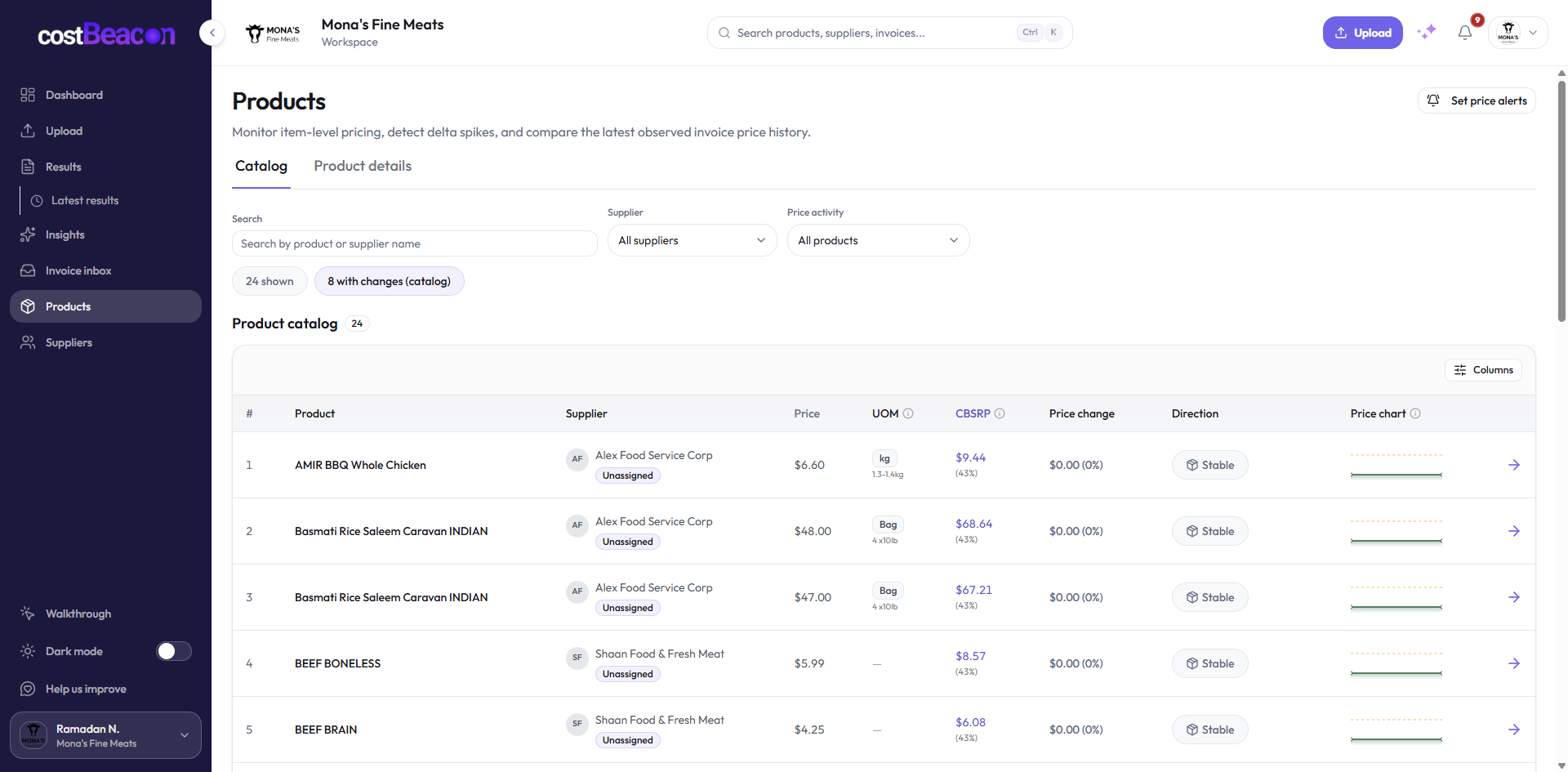
CostBeacon does not replace your accounting system's official financial statements or track every inflation category automatically. It gives operators a clearer view of the supplier invoice data that explains why product costs are moving.
Final takeaway: inflation will always be part of the business cycle. Businesses that understand their costs in real time are better prepared to protect margins with pricing, negotiation, purchasing, and operational decisions.
FAQ
Common questions
How does CostBeacon help with supplier costs?
CostBeacon extracts line-item costs from supplier invoices and tracks product history so you can see price changes before margin is squeezed.
Do I need QuickBooks?
No. CostBeacon works from uploaded invoices; QuickBooks Online sync is optional.