

Margins rarely disappear all at once. They usually erode slowly: a supplier raises the price of a key item by a few percent, freight fees creep into invoices, packaging costs increase, discounts disappear, or a recurring charge changes without anyone noticing.
For businesses that buy products, ingredients, materials, or supplies from vendors, supplier costs are one of the biggest drivers of profitability. If those costs are not tracked carefully, even strong sales can hide weakening margins.
CostBeacon turns this workflow into an invoice-backed system: see the invoice price tracking product, compare plans and trial options, or review our supplier price tracking software page for the commercial overview.
The businesses that protect their margins are not always the largest. They are the ones with the clearest view of what they are buying, what they are paying, and when costs are changing.
Understanding supplier cost pressure
Every business that depends on vendors is exposed to supplier cost pressure. A restaurant may see increases in ingredients, packaging, cleaning supplies, and delivery fees. A manufacturer may see higher costs for raw materials, components, freight, and production inputs. A retailer may see wholesale prices shift across hundreds or thousands of SKUs.
These changes flow directly into Cost of Goods Sold, or COGS. When COGS rises faster than revenue, gross margin falls. If that continues long enough, the business may sell more while keeping less.
The key idea: you cannot manage margin if you do not know which supplier costs are changing.
Why margin protection depends on better invoice data
Most businesses already have the data they need to protect margins. It is sitting inside supplier invoices.
The problem is that invoice data is usually messy, scattered, and difficult to analyze. Invoices arrive as PDFs, emails, scans, spreadsheets, or accounting entries. Product names may vary. Unit sizes may be inconsistent. Supplier descriptions may change. Freight and fees may be buried in line items.
If invoice review is manual, price changes are easy to miss. A finance or operations team may approve an invoice because the total looks reasonable, without noticing that a specific item increased from $42 to $47 per case.
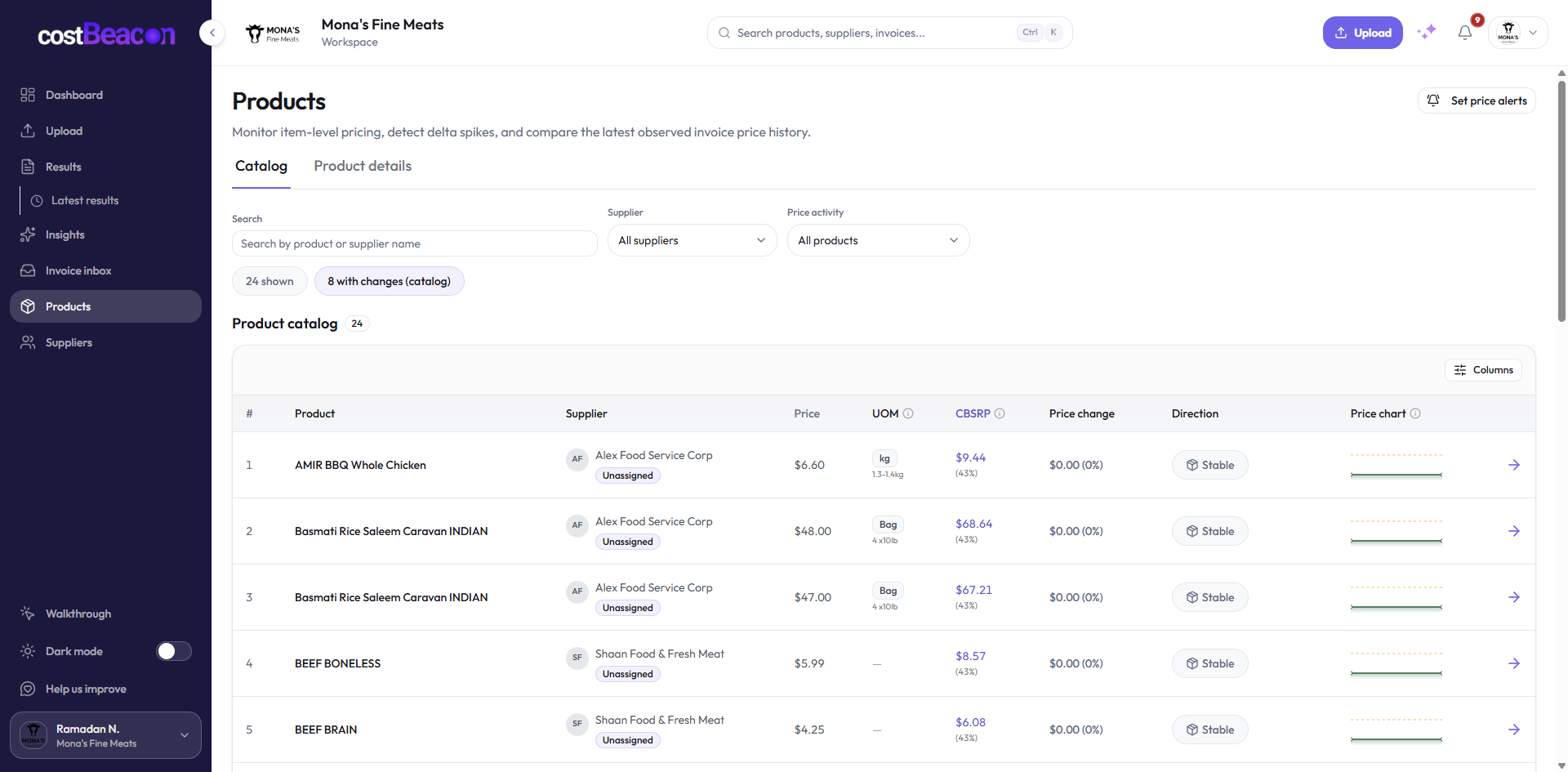
CostBeacon helps businesses turn invoices into structured cost data. Instead of relying on manual review, CostBeacon extracts supplier, item, quantity, unit price, date, and cost information so teams can see what changed, where margins are under pressure, and which suppliers need attention.
Catch the line-item change before it becomes a monthly surprise.
Compare invoice lines against historical item costs.
Prioritize the items creating the largest margin pressure.
Bring supplier spend and price movement into the conversation.
Review changes before month-end reporting arrives.
Strategy 1: track supplier price changes automatically
The first step in protecting margins is knowing when supplier prices change. Most cost increases are not dramatic enough to trigger immediate alarm. A supplier may raise an item by 3%, add a surcharge, change the pack size, or remove a discount.
Businesses should track prices at the item level, not just at the invoice total level. That means monitoring supplier name, item description, SKU or product code, quantity, unit cost, pack size, freight charges, discounts, invoice date, and historical price.
CostBeacon automatically detects supplier price changes from incoming invoices and flags them for review. If a product that usually costs $18.50 per unit suddenly appears at $20.25, your team can see the change immediately and ask whether the increase was expected, approved, temporary, or tied to a packaging change.
Strategy 2: use invoice data to strengthen supplier negotiations
Supplier negotiations are much stronger when they are based on real purchasing data. Many businesses negotiate from memory or general frustration: "Our costs are too high." That is rarely persuasive.
A better approach is specific: "Over the last six months, our unit cost for this item increased 11%, while our purchase volume stayed consistent. We bought $82,000 from you during that period. Can we review pricing, volume discounts, or alternative product options?"
Before negotiating, businesses should understand total spend by supplier, spend by item or category, price changes over time, purchase volume trends, invoice accuracy, delivery or service issues, comparable supplier options, and contract terms.
The goal is not always to force the lowest possible price. Sometimes the better outcome is price stability, better payment terms, freight concessions, volume discounts, or early notice of future increases. Better data creates better leverage.
Strategy 3: identify the items driving COGS increases
Not every supplier cost matters equally. Some items are low-volume and low-impact. Others are critical inputs that heavily influence COGS. If those high-impact items increase, margins can move quickly.
A food business may discover that overall supplier spend increased by 6%, but most of the impact came from only five ingredients. A manufacturer may find that one component is responsible for a large share of COGS increase. A retailer may see that certain product categories are no longer profitable at current selling prices.
Once you know the cost drivers, you can renegotiate specific items, find alternative suppliers, adjust selling prices, change pack sizes, reduce waste, shift sales toward higher-margin products, or review freight and surcharge policies.
Strategy 4: reduce invoice errors and overpayments
Margin erosion does not only come from inflation or supplier price increases. It can also come from invoice mistakes. A supplier may bill the wrong price, duplicate a charge, apply the wrong quantity, miss an agreed discount, include an unexpected fee, or charge freight incorrectly.
The traditional approach is to review every invoice manually. That is slow, repetitive, and easy to get wrong. A better approach is exception-based review: use software to flag the lines that need attention.
Strategy 5: build a real-time margin monitoring process
Margin protection should not happen only at month-end. By the time financial statements show a margin decline, the business may have already processed weeks or months of higher supplier costs.
A better system monitors cost changes continuously. That may include weekly supplier price-change reviews, monthly COGS analysis, alerts for major item-level increases, category-level cost trend reporting, supplier scorecards, freight and surcharge reviews, and pricing updates based on cost movement.
Instead of asking, "Why did our margin fall last quarter?" the business can ask, "Which supplier costs changed this week, and what should we do about it?"
Common margin leaks hidden in supplier invoices
Supplier invoices often contain signals that margins are under pressure. Businesses should watch for repeated unit price increases, new fuel or delivery surcharges, changes in pack size, removed discounts, higher minimum order fees, duplicate invoices, unexpected freight charges, unusual quantity changes, seasonal cost spikes, supplier substitutions, inconsistent product descriptions, and price changes not reflected in selling prices.
These issues are difficult to monitor manually, especially as invoice volume grows. CostBeacon makes them easier to identify by extracting invoice data and highlighting cost changes automatically.
How CostBeacon helps businesses protect margins
CostBeacon is built for businesses that need better visibility into supplier costs. It helps teams understand what they are buying, what they are paying, and how those costs are changing over time.
With CostBeacon, businesses can automatically extract invoice data, track supplier price changes, monitor item-level cost history, identify COGS pressure, catch invoice anomalies, compare spend across suppliers, prepare better supplier negotiations, reduce manual invoice review, and protect margins before they erode.
Better cost visibility creates better margins
Protecting margins is not about one big decision. It is about consistently catching the small changes that would otherwise go unnoticed: a supplier price increase, a new surcharge, a missed discount, a freight fee, a duplicate charge, or a cost change that never made it into pricing.
Each one can reduce profit. Together, they can reshape the financial health of the business. By turning invoices into structured, actionable cost intelligence, teams can catch changes earlier, negotiate better, and protect margins before problems show up in the bottom line.
Final takeaway: better supplier cost visibility gives operators more time to act. The earlier a cost change is caught, the easier it is to question, negotiate, reprice, or reduce its impact.
FAQ
Common questions
How does CostBeacon help with supplier costs?
CostBeacon extracts line-item costs from supplier invoices and tracks product history so you can see price changes before margin is squeezed.
Do I need QuickBooks?
No. CostBeacon works from uploaded invoices; QuickBooks Online sync is optional.