

Effective inventory management is not just a warehouse task. For product-based businesses, it is one of the fastest ways to protect cash flow, reduce waste, avoid stockouts, and improve margins.
Picture a stockroom where boxes are stacked in corners, some products are gathering dust, and popular items are hard to find. You may have money sitting on the shelf, but not in the right products, quantities, or supplier costs.
CostBeacon turns this workflow into an invoice-backed system: see the invoice price tracking product, compare plans and trial options, or review our supplier price tracking software page for the commercial overview.
The key idea: inventory becomes profitable when stock levels, supplier costs, and demand signals are managed together. Counting boxes is only part of the work.
The true cost of too much or too little inventory
Most businesses feel safer with extra stock. That instinct makes sense, but excess inventory carries real costs. Storage, insurance, taxes, spoilage, damage, shrinkage, and capital costs all add up. Every dollar tied up in slow-moving stock is a dollar that cannot be used for payroll, marketing, equipment, debt reduction, or supplier negotiations.
Understocking hurts in a different way. If customers want an item and you cannot supply it, the business loses sales and may lose trust. Manufacturers can face idle labor and production delays. Retailers may pay rush freight to recover from stockouts, and those premium charges can erase margin.
Overstock
- Cash trapped on shelves
- Storage and insurance costs
- Spoilage, damage, and markdowns
Right stock, right cost
- Enough supply for demand
- Less idle capital
- Cleaner margin decisions
Stockouts
- Lost sales and loyalty
- Production delays
- Rush orders and freight premiums
Inventory valuation methods: FIFO, LIFO, and weighted average
Inventory valuation affects cost of goods sold, gross profit, and the way your financial statements represent inventory value. The physical stockroom may look the same, but the accounting method can change how profitable sales appear.
FIFO, or first-in, first-out, assumes the oldest inventory is sold first. It often matches the physical flow for perishable goods, food, fashion, and products with a lifecycle. In a rising-cost environment, FIFO usually produces lower COGS because older, cheaper costs are expensed first.
LIFO, or last-in, first-out, assumes the newest inventory is sold first. It can produce higher COGS during periods of rising costs, which lowers reported gross profit. LIFO is not permitted under IFRS, so it is not available to every business.
Weighted average smooths cost changes by dividing the total cost of goods available by the total units available. It is useful when products are interchangeable and individual unit tracking is impractical.
FIFO
Oldest cost goes to COGS first.
$8 COGS Higher reported margin when costs riseLIFO
Newest cost goes to COGS first.
$12 COGS Lower reported margin when costs riseWeighted average
All available costs are blended.
$10 COGS Smoother view during price volatilityForecast demand before you buy
You cannot manage inventory well if you do not anticipate demand. Forecasting uses historical sales, seasonality, promotions, market changes, supplier availability, and upcoming business plans to estimate what customers will buy.
The goal is not perfect prediction. The goal is to be directionally right and reduce the cost of being wrong. Better forecasts reduce slow-moving stock, prevent avoidable stockouts, and give purchasing teams a clearer reason for when to buy and how much to order.
- Historical sales: look at month-to-month and year-over-year patterns.
- Seasonality: adjust for weather, holidays, local events, and recurring spikes.
- Promotions and launches: build expected demand changes into purchasing plans.
- Supplier constraints: consider lead times, minimum order quantities, and reliability.
Reduce waste and obsolescence
A lean stockroom is not just neat. It is less expensive. Waste shows up as expired food, obsolete components, damaged packaging, dead seasonal stock, trim loss, returned goods, and products that must be discounted to move.
Just-in-time purchasing can reduce carrying costs, but it depends on reliable suppliers and short lead times. ABC analysis helps prioritize management attention: high-value A-items need tight control, B-items need regular review, and low-value C-items can use simpler routines.
Cycle counting keeps records accurate without shutting the business down for a full physical count. Instead of waiting for an annual surprise, teams count small groups of items on a rotating schedule and correct discrepancies early.
Use reorder points, safety stock, and order quantities
A reorder point tells you when to place the next order. It combines lead time demand with safety stock. If it takes 10 days to receive an order and you sell 5 units per day, lead time demand is 50 units. Add 10 units of safety stock, and the reorder point is 60 units.
Reorder quantity answers the next question: how much should you buy? The best answer balances the cost of placing orders, shipping, storage, spoilage, supplier minimums, and available cash.
How technology improves inventory cost control
Manual spreadsheets and clipboards can work for a very small operation, but they become fragile as products, suppliers, and locations grow. Manual systems create typos, delayed updates, limited reporting, and slow reactions to cost changes.
Inventory management systems and ERP tools help teams track quantities, locations, reorders, barcodes, RFID scans, transfers, and multi-location stock. AI and analytics can improve demand forecasting, promotion planning, and anomaly detection.
There is one cost-control detail that often falls between systems: the unit cost on supplier invoices. A stockroom system may tell you how many units you have, but supplier invoices tell you whether those units are becoming more expensive.
How CostBeacon supports inventory cost decisions
CostBeacon is not a full inventory management system and does not replace physical stock counts, barcode scanning, or ERP quantity controls. It helps with a related problem: turning supplier invoices into structured item-level cost data.
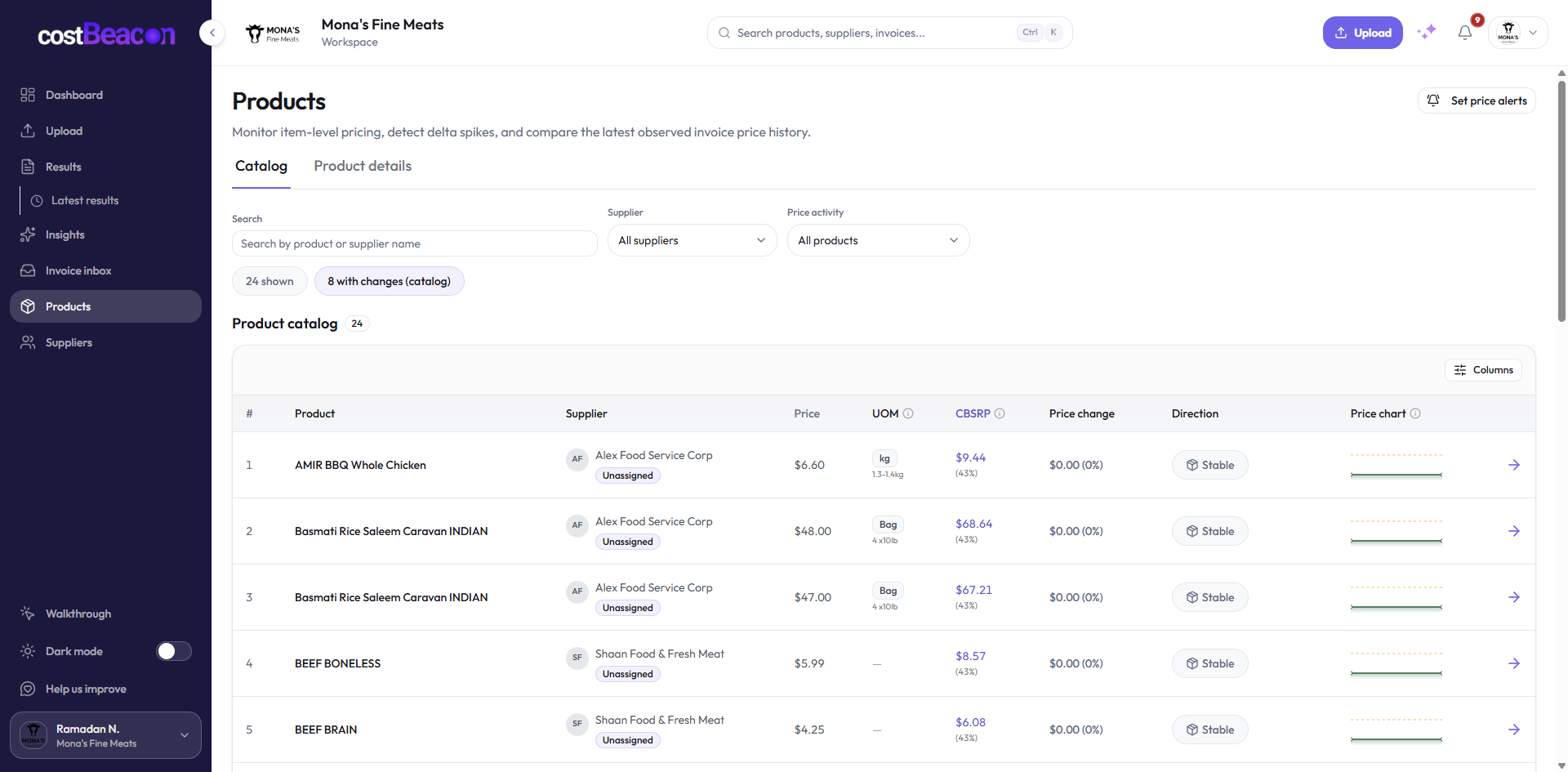
As invoices are uploaded and processed, CostBeacon tracks suppliers, products, unit costs, price changes, and price history. That makes it easier to spot when a key ingredient, material, component, or resale product has become more expensive before the increase quietly compresses margin.
Make inventory control a continuous habit
Inventory management is not a one-time cleanup. Market conditions, customer preferences, supplier reliability, lead times, and input costs change constantly. Review inventory turnover, days sales of inventory, stockout rates, carrying costs, and supplier price movement on a regular rhythm.
The best inventory systems create feedback loops between sales, operations, procurement, and finance. Sales can flag demand changes. Operations can flag waste and stockroom problems. Procurement can flag supplier delays and price changes. Finance can show where cash is trapped.
Final takeaway: inventory control protects more than shelves. It protects cash flow, customer trust, and gross margin. The businesses that know both stock levels and supplier costs are better equipped to buy, price, and negotiate with confidence.
FAQ
Common questions
How does CostBeacon help with supplier costs?
CostBeacon extracts line-item costs from supplier invoices and tracks product history so you can see price changes before margin is squeezed.
Do I need QuickBooks?
No. CostBeacon works from uploaded invoices; QuickBooks Online sync is optional.